简体中文
 English
 اللغة العربية
 Español



The Geometric Moat of Multi-Roll Pilgering: Compared to one-dimensional cold drawing, premium industrial tubes undergo cold reduction via periodic multi-roll (three-roll or multi-die) pilger mills. The process detail relies on the synchronized kinematics of the tapered dies and a internal mandrel, compressing the metal under a three-dimensional compressive stress state. This structural distribution eliminates longitudinal ears and transverse eccentricity, locking Outer Diameter (OD) and Wall Thickness (WT) tolerances within ±0.05 mm.
Managing Residual Stresses and Work Hardening: Cold reduction causes an exponential spike in dislocation density within the crystal lattice, triggering work hardening (elevating yield limits while dropping elongation properties). Fabricators must tightly govern the reduction per pass (typically held between 40% and 60%). Excessive pass deformation initiates sub-surface micro-voids and tears, whereas insufficient reduction fails to drive complete grain refinement during subsequent recrystallization.
The Thermodynamic Window: For classic austenitic configurations (e.g., 304L, 316L), the solution annealing process details require heating the matrix into a precise thermal window of 1040°C to 1150°C. At these temperatures, dislocations undergo recovery and dynamic recrystallization, forcing intergranular Chromium Carbides (Cr₂₃C₆) that formed during processing to fully dissolve back into the solid solution austenitic matrix.
Rapid Quenching Dynamics: The cooling velocity post-solution treatment is the ultimate line of defense for corrosion resistance. Pipes must be instantly brought down in temperature—typically via high-pressure water quenching or forced pure hydrogen gas circulation—to rapidly cross the critical sensitization zone (450°C to 850°C). If the cooling rate lags, atomic carbon and chromium will recombine at grain boundaries, generating fatal chromium-depleted zones that invite Intergranular Corrosion (IGC) under field conditions.
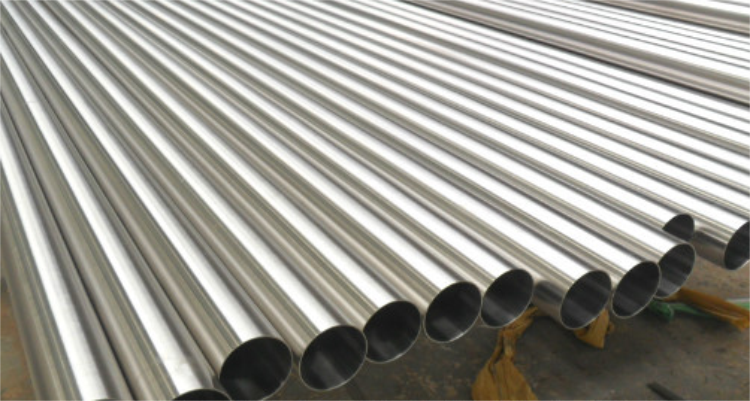 3. Cold Mechanical Cut-Off and Beveling: Eliminating Heat-Affected Zone (HAZ) Degradation
Absolute Ban on Thermal Cutting: In high-purity or high-stress piping networks, oxygen-acetylene gas cutting or standard plasma torching is strictly prohibited. The extreme thermal input causes severe local alloy segregation, structural volatilization, and carbonization along the edge, creating an uncorrectable Heat-Affected Zone (HAZ) that renders the pipe end vulnerable to premature failure before installation.
The Cold Mechanical SOP: Technicians must utilize split-frame cold sawing, orbital pipe saws, or spark-free mechanical lathes. Machining operations incorporate specialized sulfur- and chlorine-free synthetic coolants to prevent tool thermal blunting and surface chemical cross-contamination.
Beveling Engineering: For wall thicknesses exceeding 3 mm, ends are machined into a precise 30° or 37.5° V-bevel configuration. Root face tolerances are governed tightly within ±0.1 mm, and end-face squareness deviations are capped below 0.5%, providing the mandatory geometric baseline for defect-free root pass fusion.
Bright Annealing (BA) Protocol Details: Tubes undergo induction heating inside a sealed furnace charged with pure Hydrogen (H₂) or a specialized Hydrogen-Nitrogen cracked reducing atmosphere. The complete absence of oxygen arrests the formation of mill scale, locking in the shiny, cold-reduced metallic luster. The internal roughness index (Ra is typically brought to a baseline of 0.4 μm to 0.8 μm).
Electropolishing (EP) Micro-Dissolution Mechanics: The BA tube serves as the anode immersed in a customized phosphoric-sulfuric acid electrolytic bath. When high-voltage direct current (DC) is applied, the electrochemical mechanics follow the principle of micro-tip discharge: the current density at the microscopic peaks of the internal wall is exponentially higher, driving preferential anodic dissolution.
Ultimate EP Quality Metrics: Electropolishing goes beyond flattening the surface profile to achieve an ultra-smooth finish (Ra ≤ 0.1 μm to 0.2 μm). Crucially, the ionic exchange selectively strips away free surface Iron (Fe) atoms, enriching the remaining surface layer with Chromium to create an ultra-dense passive film with a Chromium-to-Iron ratio (Cr/Fe) ≥ 1.5. This maximizes corrosion barrier resistance and guarantees zero gas desorption.
-
[Company news] High quality supply of stainless steel pipe for ho......
2022-04-10
After years of development and innovation, the stainless steel pipe for household decoration has evolved from a single "slot body" to a "system" produ......
-

[Company news] Warmly celebrate the official launch of the fsunsc......
2005-07-19
Foshan Sunsco Technology Co.Ltd is located in Foshan City of China, focusing on stainless steel area for more than 12 years. With the support of the m......
-
[Industry dynamics] 304 stainless steel pipe market improves
2021-12-20
FSUNSCO Company operates a series of 304 stainless steel tubes all the year round. Stainless steel pipe, 304 stainless steel plate, 304 stainless stee......
-
[Industry dynamics] What can help us to quickly distinguish between 30......
2020-06-20
Many friends will worry when choosing stainless steel, this is because he can not distinguish between 304 and 201 stainless steel, how to quickly dist......